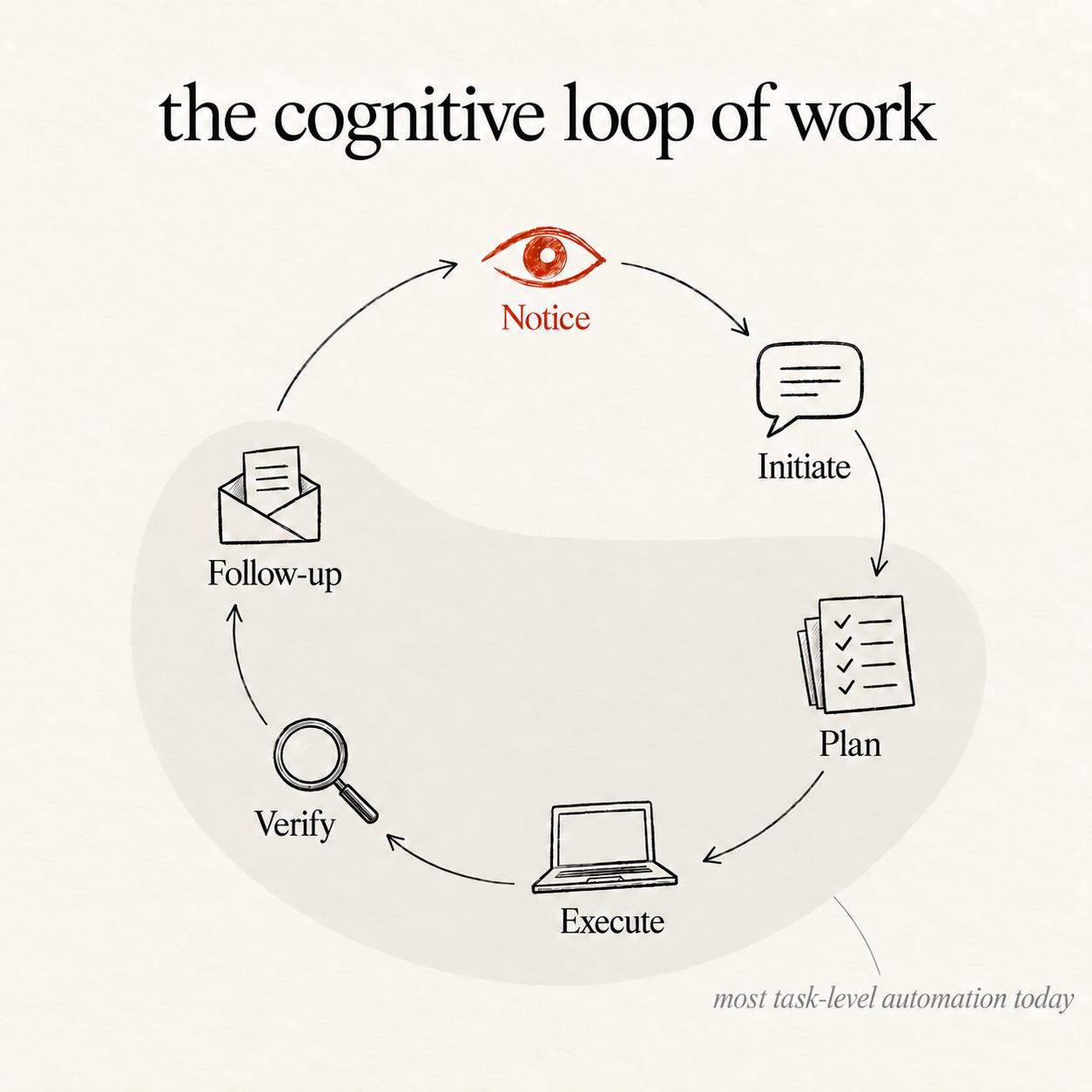
The cognitive loop of work
It's remarkable how vividly people remember little moments when someone noticed something they hadn't quite recognized themselves yet.
A few conversations this past week reminded me of a freshman-year moment: I went to pick up an assignment from my CS1101 professor, Julie Johnson, during office hours. She asked how I was doing, and I admitted I wasn't sure I was cut out for CS, I felt like I was really struggling. She pointed out that I was doing well on assignments and tests, so why did I feel otherwise? When I explained, she introduced me to the term ‘impostor syndrome’, which completely rewired my brain to see that struggling with something didn't necessarily mean I wasn't capable of doing it. I credit that conversation with keeping me in CS :)
I'm seeing a version of these moments in people's reactions to emerging personal AI assistants.
Rebecca Nathenson recently shared an experience with AVA, a family logistics assistant. It connected the dots between her son's baseball practice, a hotel stay, travel time, and a BBQ restaurant's tendency to run out of food early, and suggested preordering. What stuck with me wasn't the restaurant recommendation, it was that AVA had noticed a problem she hadn't anticipated.
What fascinates me about these moments isn't the size of the help. It’s that someone (or something) recognized something important about your situation, and offered help you hadn’t even known to ask for.
With AI agents, of course, noticing is only the beginning - reliable follow-through is what makes that help genuinely valuable. This has got me thinking about how we evaluate AI agents.
Task completion and cognitive load reduction aren't the same outcome.
Task success matters, but it doesn't necessarily capture how much work remains around the task. I think of work as a larger cognitive loop: notice → initiate → plan → execute → verify → follow up.
Imagine two assistants:
- One completes ten tasks, but I still have to identify and remember what needs doing, initiate each task, provide context, monitor execution, and chase follow-ups.
- The other completes only five, but also identifies what needs attention, manages dependencies, executes reliably, and brings me in when my judgment is actually needed.
The second might deliver dramatically more relief, despite completing fewer tasks. It's not just doing work for me…it's taking responsibility for more of the work surrounding the work.
Especially in knowledge work though, not all cognitive effort is a burden. Some of it is thinking we want to preserve. So beyond task completion, what would it mean to evaluate an agent by how much cognitive responsibility a person can genuinely, safely stop carrying?